

GHK-Cu: A Natural Peptide for Healthier, Younger-Looking Skin
What is GHK-Cu?
GHK-Cu is a naturally occurring peptide–copper complex found in blood, saliva, and urine. It supports skin repair and regeneration. As we age, GHK-Cu levels decline, which may contribute to slower wound healing, thinner skin, and visible signs of aging such as wrinkles and sagging.
How Does GHK-Cu Work?
GHK-Cu acts like a "master regulator," signaling skin cells to:
- Support collagen and elastin production (firmness and elasticity)
- Recruit repair cells to areas that need healing
- Reduce inflammation and protect against environmental damage
- Support new blood vessel formation (angiogenesis) to improve nourishment
- Support skin stem cell activity involved in healthy tissue maintenance
Research suggests GHK-Cu may influence gene activity involved in skin repair and aging-related pathways.
Benefits of GHK-Cu
Wound Healing
- May support faster healing of cuts, burns, and surgical wounds
- May promote healthy tissue remodeling and reduce excessive scarring
- Animal studies suggest improved healing timelines compared with untreated wounds
Anti-Aging and Skin Appearance
- May improve skin firmness and elasticity
- May reduce the appearance of fine lines and wrinkles
- May improve skin density and thickness over time
- May help reduce sun damage and uneven pigmentation
Topical vs. Injectable GHK-Cu
Below is a simplified comparison:
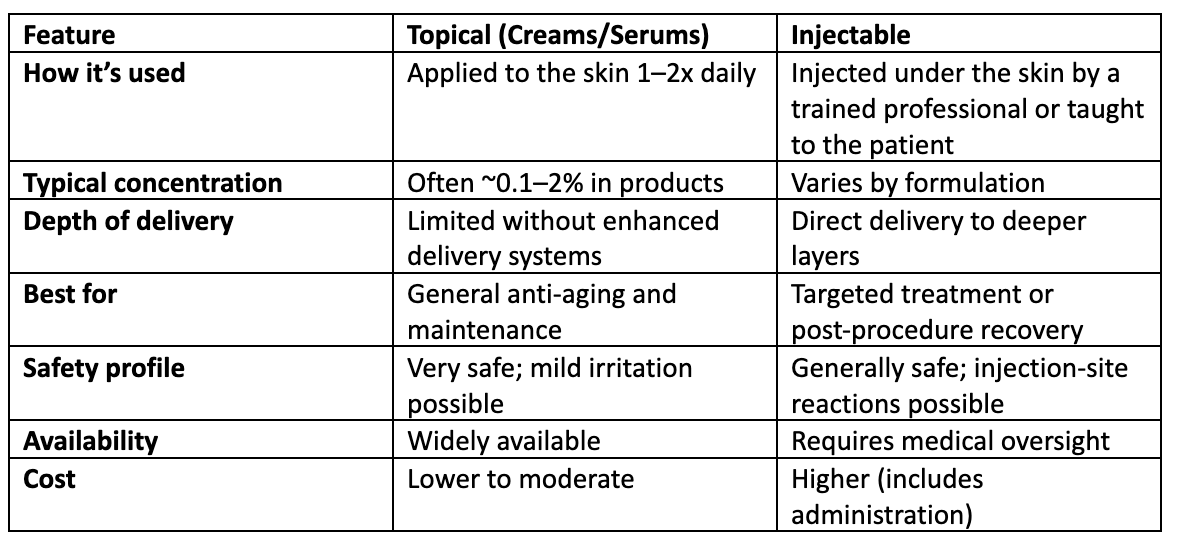
Understanding Delivery Methods
Topical GHK-Cu must pass through the skin's outer barrier (stratum corneum), which can limit penetration. To improve delivery, some formulations use:
- Liposomes (encapsulation that may improve penetration)
- Microneedling or microneedle patches (temporary micro-channels for deeper delivery)
Injectable GHK-Cu bypasses the skin barrier and delivers the peptide directly to deeper layers.
Safety Information
Topical GHK-Cu
- Mild temporary redness
- Slight itching
- Minor irritation (uncommon)
Injectable GHK-Cu
- Pain, swelling, or bruising at the injection site
- Temporary redness
- Rare risk of infection or allergic reaction
Use caution or avoid if:
- You have a known allergy to formulation ingredients
- You are pregnant or breastfeeding (insufficient safety data)
Typical Use (General Guidance)
Topical
- Common concentrations: ~0.1–2%
- Apply once or twice daily to clean skin
- Best results typically require consistent use for weeks to months
Injectable
- Dosing varies by product and treatment goal
- Administered by healthcare professionals
- May be weekly or less frequent depending on formulation
Bottom Line
GHK-Cu is a well-studied peptide–copper complex with evidence supporting roles in skin repair, tissue remodeling, and improved appearance of aging skin. Topical products are accessible and generally low-risk, while injectable forms may offer more targeted delivery but require professional administration.
References
- Pickart L, Vasquez-Soltero JM, Margolina A. BioMed Research International. 2015;2015:648108.
- Pickart L. Journal of Biomaterials Science: Polymer Edition. 2008;19(8):969–988.
- Pickart L, Margolina A. International Journal of Molecular Sciences. 2018;19(7):E1987.
- Wang X, Liu B, Xu Q, et al. Wound Repair and Regeneration. 2017;25(2):270–278.
- Kang YA, Choi HR, Na JI, et al. Archives of Dermatological Research. 2009;301(4):301–306.
- Choi HR, Kang YA, Ryoo SJ, et al. Journal of Peptide Science. 2012;18(11):685–690.
- Hur GH, Han SC, Ryu AR, et al. Journal of Peptide Science. 2020;26(2):e3234.